GW Law is currently home to ten academic journals that focus on varying legal areas, but none have an explicit substantive focus on public interest, despite GW Law’s robust public interest program. A movement to get a public interest journal recognized and established at GW Law has been ongoing since at least 2021. The Civil Rights and Civil Liberties Brief was originally formed to demonstrate the feasibility of and to bolster the movement for such a journal. Nonetheless, the efforts have thus far been fruitless. This is not, however, due to any hesitation to add more journals to the roster; last year, faculty approved another new journal, the Journal of Law and Technology (JOLT).
Now, 2Ls Christine Magume, Lara Montoya Franco, and Minnie Nelson are picking up the mantle to try to establish The Justice, Rights, and Policy Journal (JRPJ). They were selected by last year’s leaders of GW Law’s public interest journal movement Andrew Nettels and Julian Kosmides.
These students are currently circulating a petition for students to demonstrate support for the proposal. Last year, the petition acquired over 340 signatures, and at least 300 signatures have been collected already this year. According to Magume, the Student Bar Association (SBA) Senate will deliberate on a bill supporting the movement in an upcoming meeting similar to the one adopted last year.
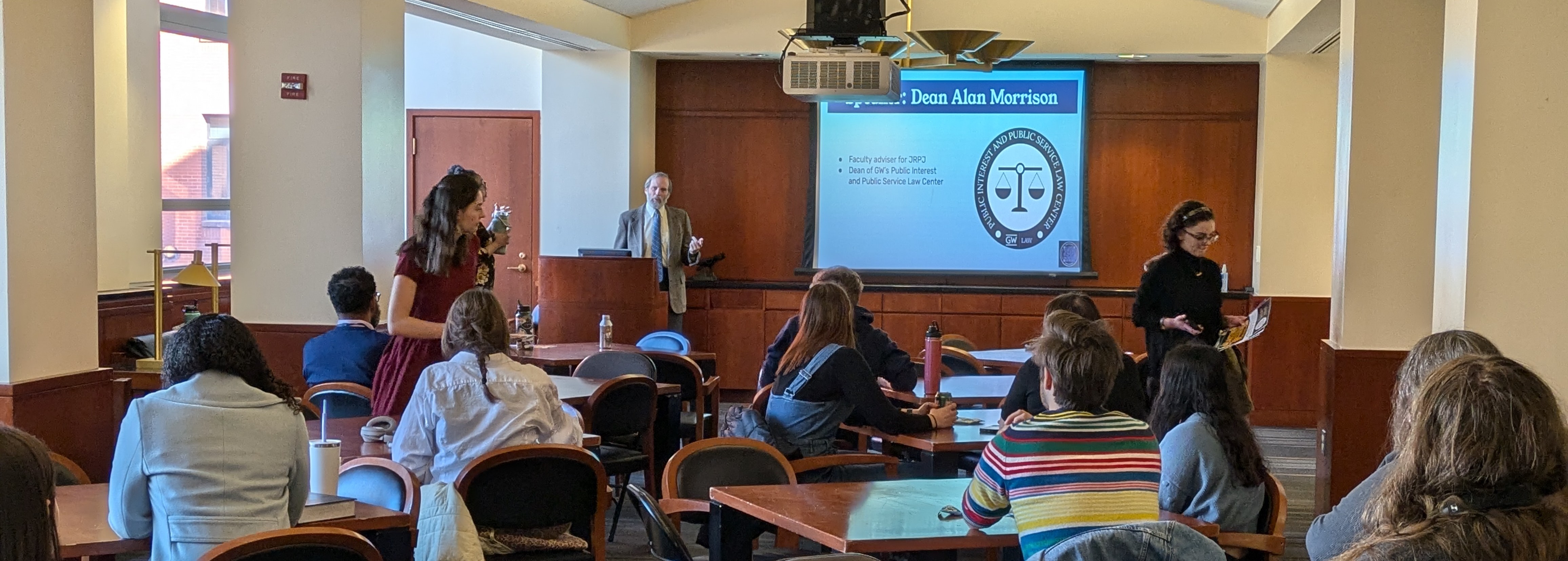
Today in the Student Conference Center (SCC), these students hosted a town hall meeting to discuss the new journal proposal. Associate Dean for Public Interest and Public Service Law Alan Morrison expressed his support and noted that students desiring a public interest journal should sign the petition and talk to their professors.
Why Public Interest?
Magume said that a public interest journal would give GW Law the opportunity to “be on the forefront” of movements in our “current political climate.” Magume noted that each of the neighboring law schools in the D.C. metropolitan area have a public interest journal.
Morrison stated, “I strongly support the creation of a public interest journal at GW Law School so that students can work on articles and write Notes in the subject areas of interest to them. I am working to help that idea come to fruition and will continue to support the proposal as much as I can.” According to Magume, other faculty have expressed interest as well.
Associate Professor Joan Schaffner said, “there are opportunities certainly for students to write in the area of public interest in all of the other journals to some degree as well as in their classes.” But Magume noted that GW Law has been positioning itself as a “public interest oriented school,” but has no journal to embody that. Magume noted that a public interest journal would “fill the gap” in scholarship regarding, for example, criminal defense topics.
How Does a Journal Get Recognized?
For a new journal to be established at GW Law, its proposal must receive a favorable majority vote of the GW Law faculty. Under the faculty’s supervision are two committees: the Journal Advisory Committee (JAC) — consisting of the editors-in-chief and faculty advisors of each journal — and the Curriculum Committee — composed of faculty members. Typically, a journal proposal must be recommended favorably by both of these committees to the full faculty in order to be approved, as the faculty usually accepts the committees’ non-binding recommendations.
The JAC is chaired by Joan Schaffner. According to Schaffner, the JAC’s “concerns are protecting the existing journals” and ensuring “the journals that we add can provide a good, rewarding, and educational experience.” The Curriculum Committee is chaired by Professor Bob Tuttle. The Curriculum Committee focuses on evaluating the “quality of the academic experience” for proposed journals.
What Happened Last Year?
Last year, the public interest journal team submitted a proposal to both the JAC and the Curriculum Committee for consideration, but the proposal stalled in both committees. At today’s town hall, Nettels said “there were many reasons” the proposal failed to pass last year, but “none of them are valid” and involved “institutional politics.” He further suggested that “footnoting has little to no pedagogical value.”
Schaffner claimed the JAC offered suggestions regarding the proposal, but due to a variety of factors — including the impending spring Journal Competition and the recent approval of JOLT — the JAC tabled the discussion. Schaffner explained the JAC was “going to be in the process of reviewing current journal policies.” Schaffner also expressed a desire to “make sure that [the proposed journal] is going to be successful” given the unique operation laid out in the proposal. Schaffner was clear that the decision was not related to the subject matter of the proposed journal.
The Curriculum Committee sought more time to evaluate journals overall. Tuttle’s concerns in prior years included “the kind of writing” not fitting existing paradigms, and he suggested that the proposed “shorter, less heavily footnoted pieces” “could be a good experience, especially if it involves writing more frequently.” He remains “optimistic” that a solution recognizing non-traditional law reviews can be reached.
What’s Different This Year?
Since last year, the team’s proposal for the journal has not changed in a substantive sense but has been rewritten in “simpler language.” Copies of the proposal were not made available to the Nota Bene. According to Magume, the heart of the proposal is a “rapid publication” process that would involve editing shorter blog-like publications. Magume said the journal would still require 2L members to write a student Note that meets the Scholarly Writing Program requirements to be eligible for publication like other journals. Magume said it would be “just like how Law Review has both.”
The updated proposal was sent to the JAC without a date certain for a decision, but at the January JAC meeting, the proposal was tabled with little debate or discussion. Tuttle said no new proposal has been received by the Curriculum Committee this year.
Schaffner said the JAC does not have “any new or different information now than [they] did last spring.” Schaffner further stated that the JAC is “not in a position to reevaluate their request at this time.”
Additionally, Schaffner claimed the issue with the proposal lies primarily with timing due to the impact adding new journals has on the operations of all journals; usually, there are several years between the additions of new journals. Schaffner said “this year is not the time that we feel we’re ready.” Given the recent changes to hours requirements for journal members, some journals next year may take less staff or otherwise change their operations. For Schaffner, adding a “completely different” journal is not a “good decision” until existing journals “have appropriate work” for their students.
Some students believe the arguments advanced by faculty are pretense. Magume said of the faculty, “if you don’t want it, then just say you don’t want it.” She continued, “we’ve gone through every single hoop that they’ve wanted.” But Schaffner was clear they were “perfectly happy to have a public interest journal,” and decisions thus far have “nothing to do with the subject matter,” but more about “operations.” And, Schaffner noted, the operational issues can be “probably overcome if we have more discussions.”
What Other Potential Concerns Exist?
According to one editor-in-chief, at the March JAC meeting last year, the head of GW Law’s Scholarly Writing Program at the time, Associate Professor Brooke McDonough, announced that no new journal adjuncts would be hired, even with the addition of JOLT. Hiring of journal adjuncts is overseen by the Scholarly Writing Program, not by the JAC. One consideration in recognizing the public interest journal is the need for an adequate journal-adjunct-to-student ratio, which may be affected if no new journal adjuncts would be hired.
Moreover, the decision to add a journal may have an impact on administrative staff including Administrative Associate Carolyn Harris, who helps with administrative tasks and office management of all journals, and her team of undergraduate work-study students. Carolyn Harris did not respond to a request for comment.



2 responses to “Students Continue Push for Public Interest Journal Amid Faculty Inaction”
The article asserts that our law school has a “robust public interest program.” But when a leading publication for aspiring law students studied clinical programs, and listed the best (at some 60 law schools), GWU Law School is not even listed – The Best Law Schools For Practical Training.
https://taxprof.typepad.com/taxprof_blog/2023/08/the-best-law-schools-for-practical-training.html
Moreover, a quick search using Google to find news and reports about our law school clinics for the past year produced virtually nothing in major media outlets not affiliated with GWU. This represents a major change from the recent past when our law school was probably best known for its students’ widely reported very successful legal actions.
I agree with Dean Morrison’s statement that “I strongly support the creation of a public interest journal at GW Law School so that students can work on articles and write Notes in the subject areas of interest to them.”
However, it would be much better if law students sincerely interested in public interest law used those same research and writing skills to produce and file legal document to serve the public interest in the real world. Here’s an example of legal writing by several GWU law students which triggered a world-wide public health revolution. It shows the kind of effective legal writing law students should be capable of.
http://banzhaf.net/by/CRASHPETITION.pdf
For those who don’t read THE HATCHET, here’s a 2/7 update on this issue:
SBA Endorses Public Interest Law Journal,
Passes Bill to Extend Budget Allocations Schedule
The Student Bar Association unanimously voted to endorse GW’s first public interest law journal at a meeting Tuesday night.
SBA senators endorsed the Justice, Rights & Policy Journal, which a group of students developed to give GW Law students a platform to write articles about public interest topics, like civil rights, human rights and environmental law. Minnie Nelson, a law student who presented to the body as a representative of the journal, said while GW currently has 10 law journals, none of them focus on public interest despite the school’s public interest law program.
“We think that there’s a big gap in the content area for students to write about,” Nelson said. “Additionally, it’ll provide an opportunity for practitioners to write about emerging public interest politics.”
Lara Montoya Franco, a law student involved in developing the journal, said a petition to launch the journal garnered 343 signatures from students last year but did not receive support from a “curriculum committee,” which presides over all of the journals at the law school. Last year’s SBA Senate also endorsed the JRPJ when students from the journal presented to the body at a March senate meeting.
She said this year they have received more than 420 signatures from students and hosted a town hall earlier this year to place “pressure” on law school officials to consider approving the journal this semester.
XXX
Let’s see if writing about public interest law results in GWU law students actually engaging in more and more effective public interest law and law reform, rather than just writing about it. By the way, one can lead to the other.
A piece I wrote as a law student resulted in a change in the law which permitted computer programs to be legally protected for the first time under existing copyright law, and eventually to a statutory revision of U.S. copyright law to better accommodate computers, programs, and data processing generally.
Another gave birth to what is now known as the “Banzhaf Index of Voting Power,” and for New York’s highest court to rule that virtually all of the weighted programs in that state were unconstitutional.